Healthcare Spending Rises When Everything Else Breaks

When the economy gets worse, most prices fall.
Restaurants run specials, Airlines drop fares, Retailers slash inventory, Businesses cut prices to stay competitive, and Workers accept lower wages to keep their jobs. That's how recessions are supposed to work. But not healthcare. Healthcare gets more expensive when the economy gets worse almost every year, no matter what. That should strike you as odd. Healthcare is a service, and Services should follow normal supply and demand. When demand drops or wages fall, prices should adjust, but they don't.
Why?

This is what the average American pays out of pocket for healthcare every year, adjusted for inflation. Which means copays, deductibles, and just about any of the other healthcare expenses your insurance doesn't cover. In real terms, it's gone from about $700 in 1970 to about $1,500 today, which is more than a 2x increase over 54 years.
That sounds tolerable, since wages have grown too, but it's worse than it looks.
Let me explain why.
Healthcare isn't a market
The first thing to understand about American healthcare is that it doesn't behave like a normal market. In a normal market, when you can't afford something, you stop buying it. If TVs got too expensive, people would skip the new TV and so demand would fall and prices would adjust.
Healthcare is different because you can't choose to skip cancer, and you can't shop around during a heart attack, and nor can you substitute a cheaper alternative for a kidney transplant. Most of the time, you can't even find out what something costs before you receive it.
So when the economy gets worse, two things happen simultaneously. People lose income, which means they can less afford healthcare, and they often need more healthcare to deal with the effects of cost cutting and worsening health.
Then there's a third thing. The system itself, meaning hospitals, insurance, pharmaceutical pipelines, has fixed costs that don't shrink when patients lose their jobs. Those costs get passed back to the patients who can still pay, or onto government programs that absorb the difference.
Healthcare is treated as essential everywhere in the developed world. The difference in America is that we've built a private system around an essential good, which creates a profit driven approach that other countries' systems insulate themselves from.
What the chart actually shows
Look at the out-of-pocket expenditure chart again, and pay specific attention to the recessions. The dip in the 1990’s was a result of Managed care and Health Maintenance organizations (the things that limit coverage to care from doctors and facilities which are “in network”.) spread aggressively in the early-to-mid 90s, which shifted a lot of cost away from patients and onto insurance pools. Then there is the slight dip in 2020, which seems counterintuitive. This was a result of People deferring elective care during COVID lockdowns, so patient-facing bills fell for a year. But what actually happened to overall healthcare spending was the opposite.
The visible cost is the tip of the iceberg
Here's where it gets interesting. If you ask most Americans whether healthcare is more expensive than it used to be, they'll say yes. But how much more expensive? The honest answer is that most people have no idea, because they don't see the full bill.
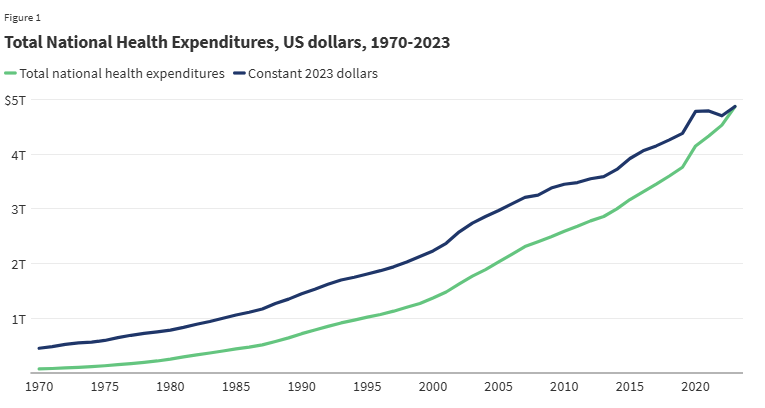
This is total healthcare spending per American, adjusted for inflation. Not just what you pay, but everything: insurance premiums, employer contributions, Medicare, Medicaid, public health spending, the whole system.
In real terms, this number has gone from about $2,200 per person in 1970 to over $15,000 today. That's roughly a 7x increase. In the same 54 years, the broader economy grew about 4x. Total healthcare cost per person grew nearly twice as fast as the economy that has to pay for it.Remember, your out-of-pocket only grew 2x. This means the other 5x has been absorbed by employers, by insurance pools, by Medicare and Medicaid, by federal programs that ratchet up every year. That's part of why prices have been able to keep rising. When most of the cost is invisible, there's less consumer pressure on prices. You can't shop around for what you can't see, but that premium comes out of your paycheck before you notice it. Your employer's contribution is hidden too, so your share of the total cost feels the same, even as the iceberg grows underneath you.
Look at 2020 again. Out-of-pocket spending dropped because people skipped elective care, but total spending surged over 10% in a single year, the biggest jump in modern history, because of federal relief to hospitals, public health emergency spending, and COVID treatment itself. The visible part shrank, but the invisible part grew faster than ever.
Healthcare as a stress signal
This is why economists who watch healthcare closely treat it almost like a thermometer. It rises with the temperature of the system's stress. Some of the rise is demographics, since an older population needs more care. But demographics change slowly, so the accelerations in the total spending chart can't be explained by aging alone. They line up too closely with economic stress to be a coincidence. In 2008, total healthcare spending grew faster than GDP for the entire decade that followed. In 2020, COVID was both a disease shock and a labor shock. Hospitals couldn't fully staff themselves, supply chains broke, and the federal government poured hundreds of billions into the system to keep it functioning. Healthcare spending jumped 10% while the broader economy contracted.
When the rest of the economy contracts, healthcare expands, and It's one of the only major spending categories that does this consistently.
The thing we don't talk about
Healthcare costs aren't really a healthcare problem, rather they're a function of how the whole economy is doing. When wages stagnate, employer health benefits absorb more of the gap. When manufacturing jobs disappear, regional hospitals lose their patient base and raise prices on what's left. When workers lose insurance, costs shift to government programs that have to expand. When the population ages and the labor market tightens, healthcare workers get paid more, which raises the cost of every visit.
Every one of these is a problem from somewhere else, showing up on the healthcare bill. Because most of those bills are hidden, in premiums and employer contributions and tax-funded programs, the political pressure to fix any of it is weaker than it should be. People don't protest costs they can't see, they only protest when they have to write the check themselves.
Saying "healthcare is too expensive" isn't quite right. The fuller statement is that healthcare reflects pressures happening everywhere else in the economy, and most of the cost is being absorbed by parts of the system most people never see. Treating the visible cost without treating the underlying stress is like turning off a smoke alarm without putting out the fire.
What I take away from this
A few things.
The out-of-pocket chart doesn't tell you how expensive healthcare actually is, the total spending chart does. The gap between them is the part of the system you're paying for but don't see, and it's been growing for fifty years.
Healthcare costs are an indicator. When healthcare spending accelerates faster than usual, it's often telling you something about the rest of the economy before the rest of the economy admits it.
The next recession won't just be an unemployment problem, It will be a healthcare cost problem too. Every previous downturn has permanently reset what the country pays for care and there's no obvious reason the next one will be different.
We treat healthcare like a separate problem because it has its own bills and its own bureaucracy. But the chart shows you something simpler. When the rest of the economy breaks, healthcare absorbs the break. Once it absorbs it, the cost doesn't leave.
Next post: Which economic numbers can we actually predict, and which ones can't we?


Comments